

Fuel Station Intelligence Platform
Forecourt, shift and finance reconciled across a station network.
PetroLink connects tank gauges, pumps, point of sale and shift procedure into one reconciled operational record, so a station network can see variance while it can still be explained.
Why PetroLink exists
Downstream retail runs on thin margins measured in fractions of a litre. Yet the control system in most networks is a paper dip book, a spreadsheet and a month-end argument.
By the time a discrepancy is visible in the ledger, the shift that caused it is weeks old, the staff have rotated and the cause is unrecoverable. The loss is written off as shrinkage.
The platform closes that gap by reconciling measurement, sales and delivery continuously, and by making the exception — not the report — the thing that reaches a manager.
In use
What PetroLink looks like day to day.
Screens from the demo environment. Station names, people and figures are demo data.
01
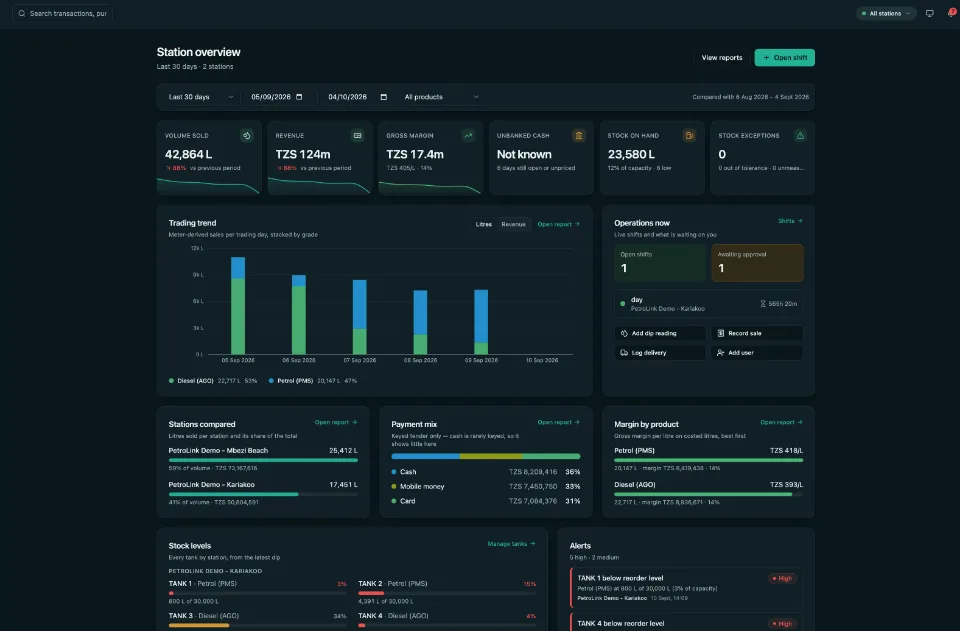
Station overview
Volume, revenue, margin, unbanked cash and stock on hand for every station on one screen, with the open shift, what is awaiting approval and the tanks that need attention.
02
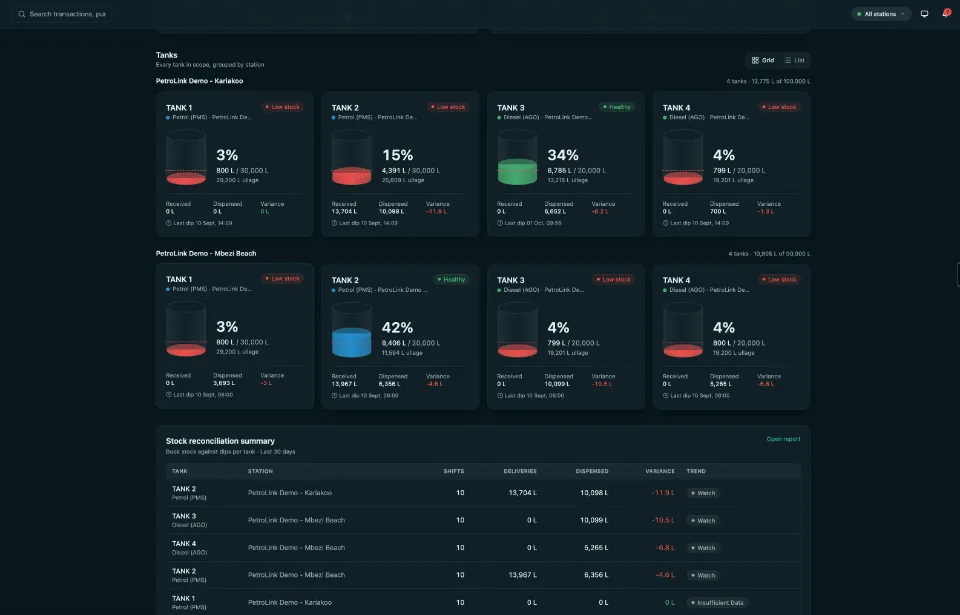
Every tank, from the latest dip
Each tank shows fill, ullage, what came in, what went out and the variance since the last dip, so a low tank or a drifting one is visible before it becomes a stock-out or a write-off.
03
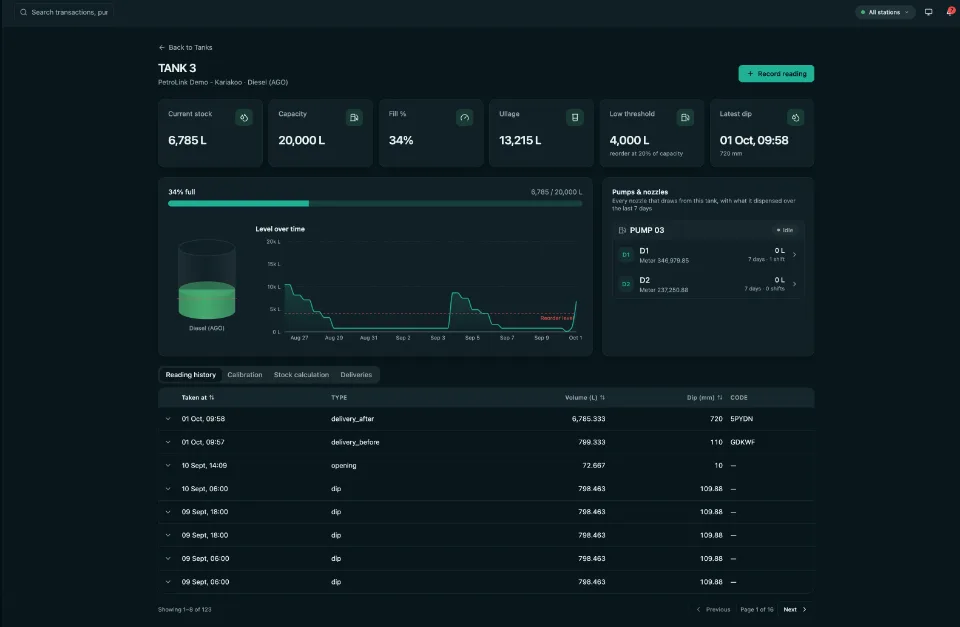
One tank, over time
Level against the reorder line, every dip and delivery in the reading history, and the nozzles that draw from the tank, so a discrepancy can be traced to a shift and a reading.
04
From the pump to the bank, per shift
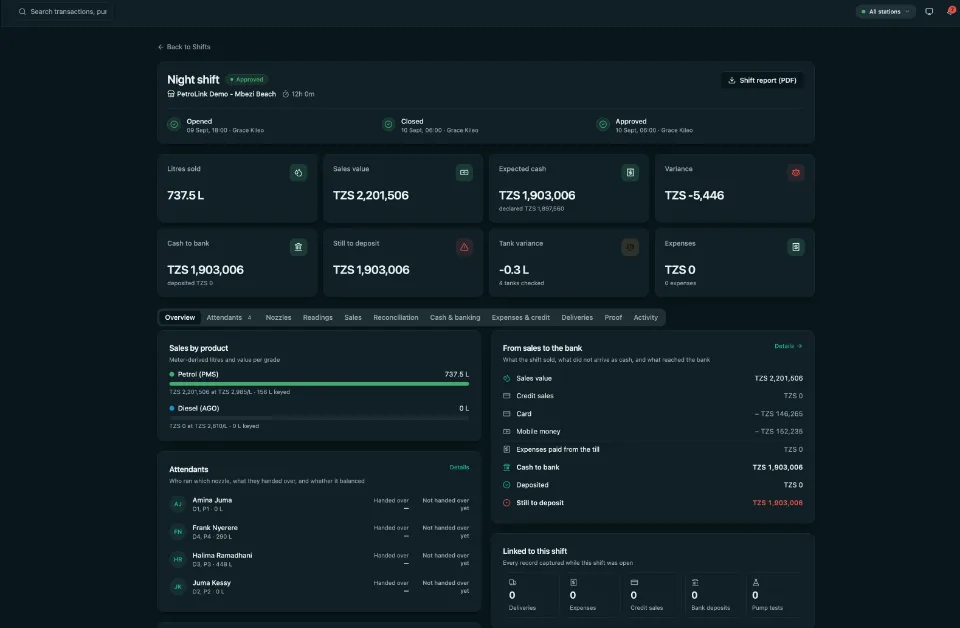
Each shift is reconciled on close: meter litres, expected cash, what each attendant handed over, card and mobile money, expenses and what still has to reach the bank. Approval is recorded with a name and a time.
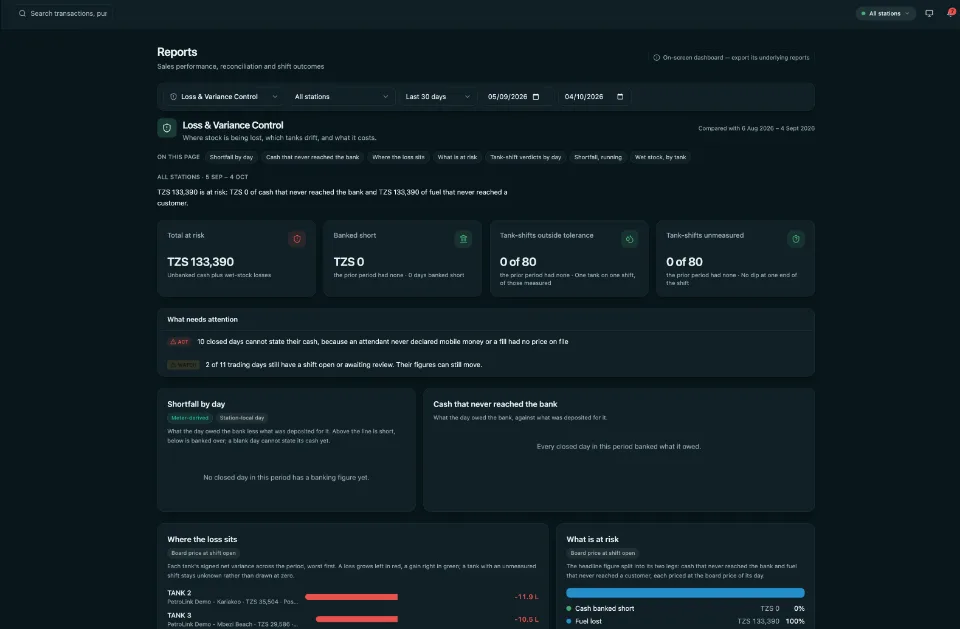
05
Where the loss sits
Unbanked cash and wet-stock loss priced at the board rate, by day and by tank, worst first. The report says what needs action today rather than what happened last month.
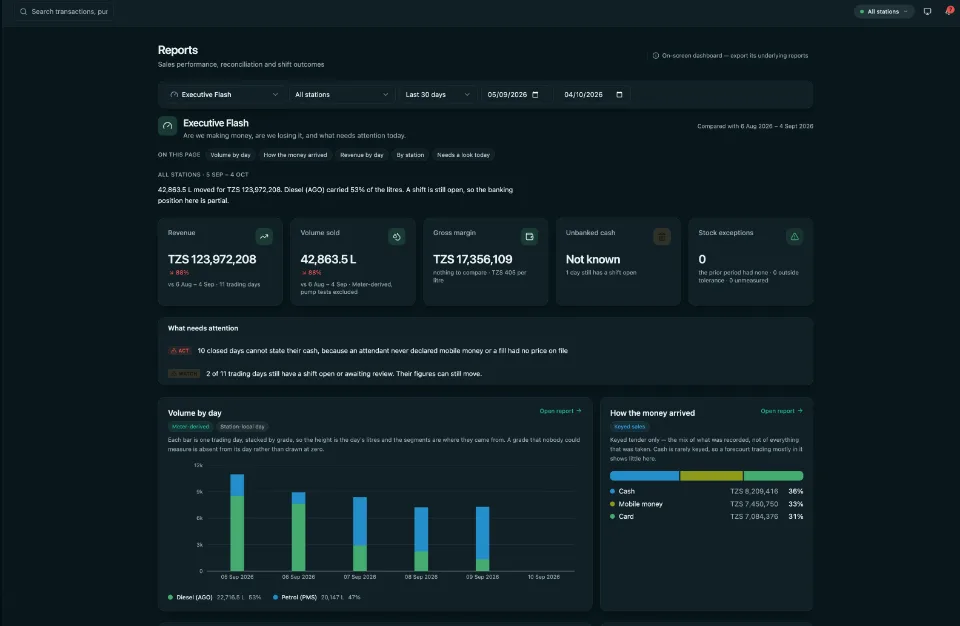
06
The owner's one-page view
Are we making money, are we losing it, and what needs attention today. Written for the person who owns the network, not the person who runs the till.
Business challenges
What it is built to answer.
The conditions the platform is designed to answer, as institutions describe them.
Wet-stock variance found at month end
Continuous reconciliation between gauged volume, dispensed volume and recorded sales exposes variance within the day.
Deliveries accepted without verification
Delivery records are matched against tank movement, so short deliveries are detected at the point of receipt.
Shift handover is undocumented
Structured shift open and close, with meter readings and cash position captured as part of the procedure.
Network performance is not comparable
Consistent instrumentation across sites makes throughput, margin and variance genuinely comparable between stations.
Architecture
How the platform is layered.
Boundaries are explicit so parts can be replaced, integrated or deployed separately as the estate changes.
- L05
Forecourt
What is measured
- Automatic tank gauging
- Pump and dispenser data
- Point of sale capture
- Delivery documentation
- L04
Site
How a station operates
- Shift open and close
- Meter and dip capture
- Cash and card position
- Local buffering
- L03
Reconciliation
Where truth is established
- Volume balance engine
- Variance thresholds
- Delivery matching
- Exception generation
- L02
Network
How the estate is managed
- Multi-site dashboards
- Comparative performance
- Price and product management
- Alert routing
- L01
Finance
What closes the loop
- Margin reporting
- Stock valuation
- ERP and ledger hand-off
- Audit evidence
Core capabilities
What it does.
Automatic tank gauging integration
Continuous tank readings from installed gauge hardware, normalised across vendors and site generations.
Shift reconciliation
Every shift closes with a balance between measured volume, dispensed volume, sales and cash.
Variance analytics
Loss patterns separated into measurement error, temperature effect, delivery shortfall and operational loss.
Delivery control
Expected against received volume per compartment, with driver and time recorded.
Exception handling
Thresholds raise a case with an owner and a resolution trail instead of a line in a report nobody opens.
Network oversight
Estate-level rollups for operations and finance, with drill-down to a single shift at a single pump.
Integrations
Where it connects.
Integration is contract-first: versioned APIs, published event schemas and adapters that isolate systems of record.
Site equipment
- Tank gauge controllers
- Dispenser interfaces
- Forecourt controllers
- POS systems
Enterprise
- ERP and general ledger
- Stock and procurement
- Payment processors
Fleet
- Fleet card programmes
- e-sync fleet telemetry
- Customer accounts
Reporting
- Data warehouse
- Regulatory reporting
- Executive dashboards
Governance & security
Control and evidence.
Measurement traceability
Every reconciliation keeps the readings it was calculated from, including source device and timestamp.
Segregation of duties
Shift staff, site managers and network finance hold distinct rights over adjustments and approvals.
Regulatory evidence
Stock movement and delivery records structured for statutory reporting and inspection.
Offline integrity
Sites continue to record and reconcile locally during connectivity loss, then synchronise.
Deployment
How it is run.
Central cloud with site agents
The standard model: a lightweight agent per station, central reconciliation and reporting.
On-premise network
Full deployment inside the operator's data centre for networks with existing infrastructure.
Phased rollout
Instrumentation introduced site by site, with the network view growing as coverage extends.
Sectors
Built for.
- Downstream fuel retail
- Fuel distribution
- Commercial fleets with private stations
- Energy & utilities
See it running on your own process.
Book a demo of any platform, or bring a problem and get scope, architecture and pricing back within a working day.